 Denver (USA)
 Riyadh (KSA)
 Islamabad (PK)
On this page
- Quick answer
- What is IT staff augmentation?
- What is a dedicated engineering team?
- What is project outsourcing?
- Decision matrix
- Find your model (5 questions)
- Practical examples
- How much does each model cost?
- Security, IP and governance
- Common mistakes
- How AXITEQ runs staff augmentation
- Frequently asked questions
- Final thoughts
Choosing an engineering delivery model is more than a hiring decision. It decides who manages the work, who owns delivery, how fast your team can adapt and how much technical knowledge stays with you.
When a team faces a capacity gap, a new product initiative or a deadline that cannot wait for recruitment, external engineers are a practical option. But the three common models, IT staff augmentation, dedicated engineering teams and project outsourcing, solve different problems.
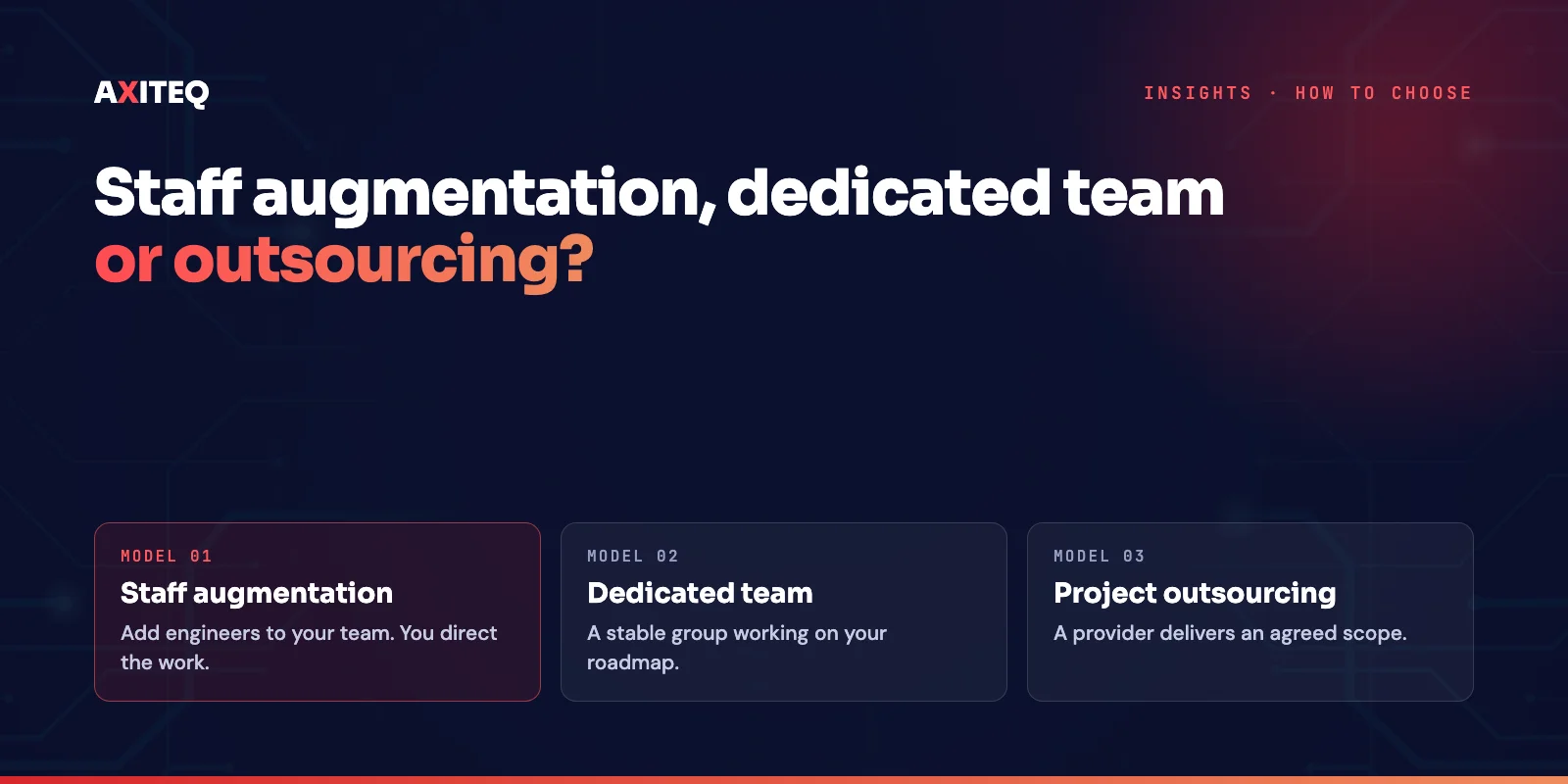
Staff augmentation adds skills and capacity to your existing team. A dedicated engineering team gives you a stable group for ongoing work. Project outsourcing hands an agreed scope of work to an external provider. This guide compares the three, explains the trade-offs and gives you a practical way to choose.
01Quick answer: which model should you choose?
IT staff augmentation
Choose it when you have technical leadership in place and need more engineers, specialist skills or temporary capacity.
- Direction
- You
- Delivery
- You keep it
- Pricing
- Per person / month
Dedicated engineering team
Choose it when you need a stable, coordinated group for an ongoing product, platform or roadmap.
- Direction
- Shared
- Delivery
- By agreement
- Pricing
- Recurring team fee
Project outsourcing
Choose it when you have a clearly defined deliverable and want a provider to manage its execution.
- Direction
- Provider
- Delivery
- Provider owns it
- Pricing
- Fixed / milestones / T&M
The right question is not which model is better in general. It is which model gives you the right balance of control, capacity, delivery ownership and flexibility.
02What is IT staff augmentation?
IT staff augmentation brings external engineers into your existing team to close a specific skills or capacity gap. They work inside your processes, tools, repositories and reporting lines. The provider handles recruitment, employment and the engagement; you direct the work.
Typical augmented roles include:
How it works in practice
Say your company is building an industrial IoT platform. Your team knows the architecture, the customers and the priorities, but lacks embedded engineering capacity. Instead of rebuilding the team, you add an embedded engineer who joins your workflow. Your tech lead assigns the work, reviews it and keeps it to your standards. You keep control of priorities and technical decisions and gain the expertise you were missing.
Advantages
- Direct control: your engineering leaders set priorities, review work and make the technical decisions.
- Targeted expertise: you close a specific skills gap without hiring a whole team.
- Flexible capacity: roles, duration and workload follow what you actually need.
- Continuity: external engineers work in your repositories, tools and documentation.
- Knowledge retention: the work lands in your environment, so it stays with you when documentation and handover are managed well.
Challenges
Staff augmentation does not replace engineering management. Someone on your side still sets direction, prioritizes tasks, reviews deliverables and resolves dependencies. It is a poor fit if nobody has time to onboard and manage the new engineers.
Organizations with established technical leadership that need extra capacity or specialist skills.
03What is a dedicated engineering team?
A dedicated engineering team is a group of professionals assigned to your product, platform or ongoing engineering work. Unlike individual augmentation, it is organized around a continuing body of work and can include software engineers, QA, DevOps, designers, business analysts and a technical or delivery lead.
The provider forms the team and keeps it stable. How day-to-day management and delivery responsibility are split is agreed between you and the provider.
How it works in practice
Imagine a connected-device platform that needs ongoing firmware work, cloud integration, mobile app improvements, testing and maintenance. A dedicated team with those disciplines works against your roadmap. You set product direction, priorities and acceptance; the team plans and reports through an agreed process.
Advantages
- Continuity: a stable team builds deep knowledge of your product, architecture and business.
- Coordinated delivery: several disciplines work to one plan.
- Ongoing capacity: the team follows your evolving requirements instead of a single deliverable.
- Less recruitment work: the provider handles hiring, team formation and replacements.
- Clear structure: defined roles make responsibilities, communication and reporting easier.
Challenges
A dedicated team needs a reasonably clear roadmap and good governance. If priorities change constantly without an agreed process, alignment suffers. It is also a continuing financial commitment, so agree the minimum term, team composition, replacement terms, scaling options and who manages delivery before you sign.
Businesses that need stable engineering capability for ongoing product development or long-term operations.
04What is project outsourcing?
Project outsourcing engages a provider to deliver an agreed project, solution or body of work. The provider takes more responsibility for execution than in staff augmentation: depending on the contract, requirements analysis, design, development, integration, testing, deployment and handover.
Write down exactly who is responsible for what. A time-and-materials project does not transfer the same delivery risk as a fixed-price contract with clear acceptance criteria.
How it works in practice
Say you need a customer portal that integrates with an existing business system. You define the requirements, functionality, constraints, security needs and acceptance criteria. The provider proposes a solution, plans it, assigns a team and delivers the agreed scope. Your stakeholders stay involved in decisions, reviews and acceptance, but the provider runs the day-to-day execution.
Advantages
- Defined responsibility: the contract sets who owns planning, build, testing and acceptance.
- Broad capability: one provider brings several disciplines, so you do not recruit each role.
- Less people management: your team focuses on direction and checkpoints, not on managing each engineer.
- Clear deliverables: milestones, acceptance criteria, documentation and handover are set up front.
Challenges
Outsourcing gets harder when requirements are unclear, priorities keep changing or the provider cannot reach the people and information it needs. Fixed-price deals can lead to disputes when assumptions change or acceptance criteria are vague, so strong contracts and change control matter.
Organizations that want a provider to deliver a defined solution under an agreed scope.
05Decision matrix: staff augmentation vs dedicated team vs outsourcing
Swipe to compare
| Decision factor | IT staff augmentation | Dedicated engineering team | Project outsourcing |
|---|---|---|---|
| Primary purpose | Fill specific skills or capacity gaps | Stable, ongoing engineering capacity | Deliver an agreed project or outcome |
| Day-to-day direction | Client-led | Agreed between client and provider | Provider-led within the agreed scope |
| Delivery responsibility | Client keeps overall responsibility | Shared or allocated by agreement | Provider owns contracted deliverables |
| Internal technical leadership | Essential | Important; provider may supply a lead | Depends on scope and model |
| Team structure | Individual specialists or a few engineers | Coordinated, continuing group | Team assembled around the project |
| Scope flexibility | High | High within agreed governance | Depends on contract and change control |
| Pricing | Per person, per hour or per month | Recurring team fees | Fixed price, milestones or time and materials |
| Knowledge continuity | Depends on documentation and continuity of people | Supported by team stability | Needs explicit handover and knowledge transfer |
| Best use case | Existing team needs more capacity | Ongoing product or platform roadmap | Defined deliverable with clear acceptance criteria |
| Main consideration | Your management capacity | Long-term commitment and governance | Scope clarity and contract risk |
No model wins every row. The right choice depends on what you can manage internally and what you want the provider to take responsibility for.
Talk it through with an engineer in 20 minutes.
We’ll tell you which model fits, even if it isn’t one we offer.
06How to choose: five questions
Answer the five questions to get an indicative recommendation. The reasoning behind each question is below.
01Do you already have technical leadership?
If an engineering manager, tech lead or CTO can assign tasks, review work and integrate external engineers, staff augmentation fits. If you want a coordinated group with help on team management, look at a dedicated team. If nobody can manage daily execution and you need a provider to own a defined deliverable, consider outsourcing.
02How clearly defined is the work?
An evolving roadmap that your team reprioritizes suits augmentation or a dedicated team. Clear requirements, dependencies and acceptance criteria suit outsourcing. Do not force an uncertain scope into a fixed price; agree the assumptions and a change process instead.
03Do you need individual skills or a complete capability?
One more firmware engineer, a cloud specialist or a QA automation engineer: augmentation is enough. A continuing mix of development, testing, infrastructure and leadership: a dedicated team. A complete solution built and handed over: outsourcing.
04How much delivery responsibility should the provider take?
With augmentation you keep responsibility for priorities, integration and outcomes. With a dedicated team it is divided between product direction, team management and governance. With outsourcing the provider can own the deliverables, but the contract must say what is included, what you supply and how acceptance works. Do not assume the model name defines accountability; confirm it in writing.
05What happens after the engagement?
A short-term gap and a long-term roadmap are different problems: augmentation for temporary specialist needs, a dedicated team for continuity, outsourcing for a defined project with a clear handover. In every case, agree documentation, access removal, intellectual property and knowledge transfer before the engagement ends.
07Practical examples: which model fits?
These scenarios are illustrations of how the decision works, not descriptions of AXITEQ client engagements.
A product team needs more embedded engineers
An industrial technology company builds connected devices. Its engineers own the architecture and firmware repository, but the next release needs more embedded capacity.
The company can direct the work and integrate specialists without handing over the product. If the need grows into a continuing multidisciplinary function, a dedicated team becomes the better fit.
A business needs a long-term IoT platform team
A company will build and run a platform covering device connectivity, cloud services, dashboards, integrations and ongoing features.
The work needs continuity across disciplines. The company should still define who owns architecture, security, releases and delivery decisions.
A company needs a defined business application
A business wants a customer portal with set user roles, workflows, reporting, integrations and acceptance criteria, and has little capacity to manage software delivery.
Use a statement of work covering deliverables, milestones, dependencies, acceptance tests, intellectual property, support and change control.
Specialist expertise, uncertain roadmap
An organization is modernizing a legacy platform; the technical path will change as integrations are discovered.
Staff augmentation if internal leadership can steer the work, or a dedicated team if it needs a continuing group. A short discovery phase can firm up the scope before any fixed-scope outsourcing.
08How much does each model cost?
There is no universally cheapest option, because each model leaves different responsibilities with you.
IT staff augmentation
Hourly, daily or monthly rate per engineer
Add your own costs for onboarding, management, tooling, security administration and code review.
Dedicated engineering team
Team composition, seniority, commitment and duration
Plus delivery leadership and continuity arrangements.
Project outsourcing
Fixed price, milestone-based or time and materials
Fixed price works when scope and acceptance are clear; changes, dependencies, support and exclusions move the final cost.
Compare total cost, not the quoted rate
- Engineering or project fees
- Internal management effort
- Recruitment and onboarding
- Infrastructure and tooling
- Rework and integration
- Change requests
- Documentation and handover
- Ongoing maintenance and support
- Exit and transition costs
A lower quote is not always a lower total. Compare proposals on the same scope, assumptions, responsibilities and quality expectations.
09Security, intellectual property and governance
Intellectual property
State who owns new source code, designs, documentation, firmware and configuration. Handle pre-existing IP, third-party libraries and open-source components separately.
Access and data security
Least-privilege access, approved environments, strong authentication and documented access removal. Set confidentiality and data-handling rules before work starts on sensitive systems.
Quality and acceptance
Agree coding standards, reviews, testing, defect management, deployment and acceptance criteria.
Documentation and knowledge transfer
Require usable documentation throughout, not only at the end: architecture decisions, setup, interfaces, tests, deployment and runbooks.
See how we approach it on our Security page.
10Common mistakes
- Choosing on price alone.
A low rate says nothing about management structure, expertise, continuity or accountability.
- Buying augmentation without management capacity.
Extra engineers cannot make up for missing priorities, decisions or code review.
- Outsourcing an undefined project.
Unclear requirements and acceptance criteria lead to disputes, delays and change requests.
- Treating a dedicated team as self-managing.
It still needs product direction, governance, stakeholder access and clear decision rights.
- Ignoring the exit plan.
Every engagement needs knowledge transfer, code access, documentation and account closure agreed up front.
Engineers on your terms: remote, hybrid or onsite.
AXITEQ provides engineering and technology services across IoT, industrial automation, software and digital transformation, with offices in Denver (USA), Riyadh (KSA) and an engineering hub in Islamabad (PK). For teams that already have technical leadership and need more capacity, our Resource Augmentation service is the natural starting point. When the need is a complete solution, we also deliver projects end to end, from IoT development to web and mobile development.
 Denver (USA)
 Riyadh (KSA)
 Islamabad (PK)
- The business objective and technical challenge
- The roles, skills and seniority you need
- Expected duration and working arrangements
- Your architecture, tools and delivery process
- Who leads and manages the work
- Security, IP and documentation requirements
- Target start date and constraints
12Frequently asked questions
What is the main difference between staff augmentation and outsourcing?
Staff augmentation adds external engineers to your team, and you direct their work. Project outsourcing gives an agreed scope to a provider that manages execution under the contract. The difference is who manages the work and who is responsible for the deliverables.
Is a dedicated engineering team the same as staff augmentation?
No. Augmentation adds individuals to your existing team and management structure. A dedicated team is a continuing group, often with its own technical or delivery lead. The exact split of management depends on the agreement.
Which model is best for a startup?
A startup with an experienced technical founder and a specific skills gap usually benefits from staff augmentation. One building a product with ongoing multidisciplinary needs may prefer a dedicated team. One that wants a bounded deliverable without managing it day to day can consider outsourcing.
Which model gives the most control?
Staff augmentation gives you the most direct control over engineers and daily priorities. A dedicated team shares responsibilities by agreement. Outsourcing gives the provider more control over execution within the scope. Put control and accountability in the contract.
Is staff augmentation suitable for IoT and embedded projects?
Yes, when you have the technical leadership to integrate specialists such as embedded and firmware engineers, connectivity specialists, cloud engineers and test automation engineers. Hardware access, device testing, labs, certification and safety-critical work need extra attention during onboarding.
How should I compare staff augmentation proposals?
Compare technical fit, relevant experience, seniority, availability, communication, commercial terms, replacement terms, security practices and onboarding. Check how well the proposed engineers fit your architecture and workflow, and never compare hourly rates on their own.
Is fixed-price outsourcing always cheaper?
No. It gives cost certainty for a well-defined scope, but the price includes an allowance for risk, and changes add cost. Compare the full terms, assumptions, exclusions and acceptance criteria.
Can a company combine staff augmentation and a dedicated team?
Yes. Many run a dedicated team for ongoing platform work and add individual specialists for temporary gaps. Define reporting lines, technical ownership, priorities and accountability across both.
What should an engineering services agreement include?
Scope, roles, fees, duration, responsibilities, intellectual property, confidentiality, security, deliverables, quality standards, acceptance, change control, documentation, termination and knowledge transfer. Regulated or sensitive projects may need more.
How do I get started with AXITEQ?
Write down the technical challenge, the skills you need, expected duration, your current team structure and target start date. Then explore Resource Augmentation and contact us to discuss the options.
13Final thoughts
Staff augmentation suits teams that need more skills and can manage the work. Dedicated teams suit continuing roadmaps that need stable collaboration. Outsourcing suits clearly defined deliverables a provider can own.
Before comparing proposals, answer three questions- How much engineering management capacity do you have?
- How defined (and how likely to change) is the work?
- Which responsibilities do you want to keep, share or hand over?