On this page
In cold chain, a refrigeration fault found the next morning is already a loss. The stock is gone, the compliance log has a gap and someone has to explain it to a customer.
Continuous monitoring changes that: the fault is seen when it starts, not when the shift opens. In a representative deployment, AXITEQ monitored more than 200 refrigeration units around the clock, and spoilage incidents dropped to near zero within 60 days.
This article explains what made the difference: not just sensors, but a 24/7 network operations centre (NOC) that owns every alarm until it is resolved.
01Quick answer: monitoring, alarms or a managed NOC?
Thermometers and manual logs
Readings taken by staff a few times a day and written down for compliance.
- Detects
- At the next check
- Owner
- Store staff
- Records
- Manual
Sensors with local alarms
Sensors raise an alarm on a panel or one phone when a threshold is crossed.
- Detects
- In real time
- Owner
- Whoever sees it
- Records
- Partial
Managed 24/7 NOC
Every alarm becomes an incident with an owner, an SLA timer and a full record.
- Detects
- In real time
- Owner
- NOC engineers
- Records
- Automatic
Sensors detect a rising temperature. Ownership is what saves the stock: someone has to see the alarm, decide it is real and get a technician moving.
02Why cold chain operations stay reactive
Most supermarket chains and cold storage operators already have thermometers, and many have alarms. They still lose stock, for the same few reasons:
- Failures are found too late.
Often at opening time, after hours of rising temperature.
- No real-time view across sites.
Head office learns about problems from store reports.
- Manual temperature logs.
Food safety records are written by hand, with gaps and guesswork.
- Alarms without an owner.
Alerts go to a local panel or a single phone, and nobody is clearly responsible.
- No history for audits.
There is nothing to show auditors or insurers what happened and when.
03What a cold chain NOC does
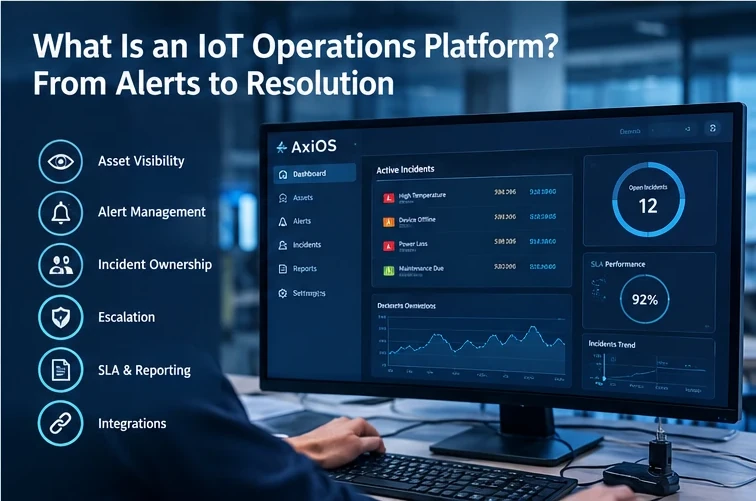
AXITEQ runs cold chain monitoring on AxiOS, its operations intelligence platform, with AXITEQ engineers watching the console around the clock.
Every unit, every site
Watches every chiller, freezer and cold room in real time, across all sites, on one console.
Incidents with SLA timers
Raises incidents automatically, with SLA timers and escalation workflows.
Compliance without paperwork
Produces compliance reports automatically, replacing manual temperature logs.
Energy analytics
Spots refrigeration that is running inefficiently, which often points to a fault in the making.
Each customer also gets its own portal, so store and operations managers see the same data as the NOC.
04From signal to resolved: how an incident is handled
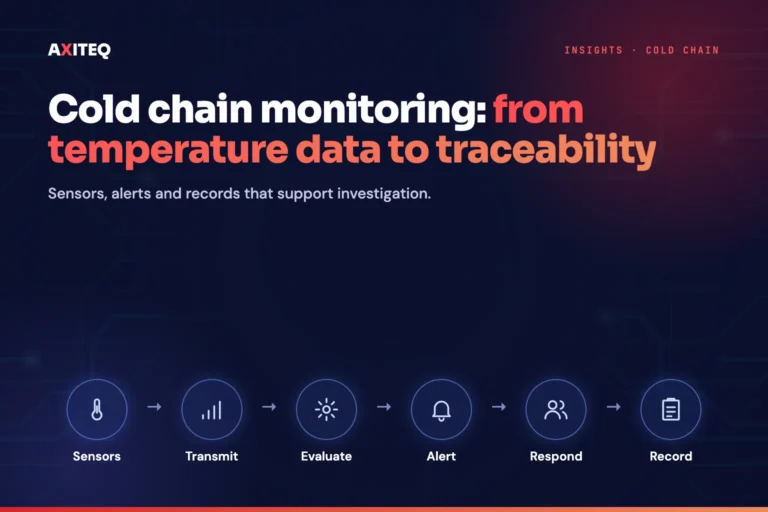
Every alarm in AxiOS moves through the same loop: monitor, detect, respond, resolve, report and improve. Here is what that looks like when a chiller starts to fail.
Monitor
Sensors report cold room and display case temperatures continuously; gateways buffer the data if connectivity drops.
Detect
When a temperature crosses its threshold, an incident opens automatically and the SLA timer starts.
Respond
The site supervisor is notified by app and SMS, and the NOC confirms whether the alarm is real or, for example, a door left open.
Resolve
If equipment is at fault, a technician is dispatched. Escalation rules move the incident to a senior engineer if it is not handled in time.
Report
The full timeline, from first alarm to fix, is kept as an audit trail and appears in the compliance report.
Improve
Recurring faults and energy patterns feed back into maintenance plans, so the same failure is less likely next time.
A chiller in a Riyadh store crosses 5 °C at 09:41. The incident opens at once and the SLA timer starts. The site supervisor is notified by app and SMS two minutes later, a technician is dispatched, and an escalation rule is armed in case the fix runs late. (Illustration based on the AxiOS sample screens.)
05Why a managed NOC, not just a dashboard
A dashboard shows a problem to whoever happens to be looking. A NOC makes sure someone is always looking, and that every alarm has an owner, a deadline and a record. That is the difference between monitoring and operations.
Advantages
- Clear ownership: each incident has an assignee and an SLA timer, so alarms are not silently acknowledged and forgotten.
- Fewer false alarms: thresholds and alarm delays are set per site and per asset, so teams trust the alerts they receive.
- Compliance without paperwork: temperature history and incident timelines are recorded automatically and ready for auditors.
- Lower energy costs: the same data shows units that run too often or too long, which points to failing seals, dirty coils or poor settings.
Challenges
A NOC only works if sites act on what it raises. Agree who on each site receives alerts, who can dispatch a technician, and what happens out of hours before go-live.
06What a deployment looks like
Most cold chain projects start with a survey of the sites and refrigeration assets, then a pilot on a limited number of stores or rooms to confirm data quality and alarm settings.
Survey
Sites, assets and data points
Which units, which sensors, how data leaves each site.
Pilot
As little as 30 days
A limited set of stores or rooms to validate data and alarm settings.
Rollout
Typically 60 to 180 days
Depending on the number of sites, the equipment and the systems to integrate.
Where possible, AXITEQ connects to the controllers and sensors already in place and adds new sensors only where data is missing. See why retrofit-first IoT beats rip-and-replace.
One platform, one NOC, every site.
The cold chain module is one part of AxiOS. The same platform and NOC also cover energy, telecom sites, agriculture, water and industrial IoT, so operators with mixed estates can run everything from one place. Read more about retail and cold chain and our IoT services.
 Denver (USA)
 Riyadh (KSA)
 Islamabad (PK)
- Your sites, refrigeration assets and existing controllers
- Who receives alerts today, and what happens next
- Compliance and reporting requirements
- A pilot scope and timeline
08Frequently asked questions
What is a cold chain NOC?
A network operations centre for cold chain is a team that monitors refrigeration assets around the clock, handles every alarm through to resolution and reports on it. At AXITEQ the NOC runs on the AxiOS platform and is staffed by AXITEQ engineers.
Can you monitor the refrigeration equipment we already have?
Usually, yes. Existing controllers can often be connected over standard protocols, and non-invasive sensors are added where data is missing, so stores keep operating during installation.
How are alarms sent to our team?
Incidents open automatically in AxiOS. Site staff are notified through the app and by SMS, and escalation rules move unresolved incidents to the next level.
Does it help with food safety compliance?
Yes. Temperature history, alarms and the actions taken are recorded automatically and compiled into compliance reports, replacing manual logs.
Which sites can it cover?
Supermarkets and hypermarkets, cold storage warehouses, distribution centres and any site with chillers, freezers or cold rooms, across multiple cities and countries.
09Final thoughts
Cold chain losses rarely come from a lack of sensors. They come from alarms nobody owns. A managed NOC turns every alarm into an incident with an owner, a deadline and a record.
Before choosing a monitoring setup, ask three questions- Who sees an alarm at 3 a.m., and what do they do?
- Can you prove to an auditor what happened and when?
- Which units are already telling you they are about to fail?