On this page
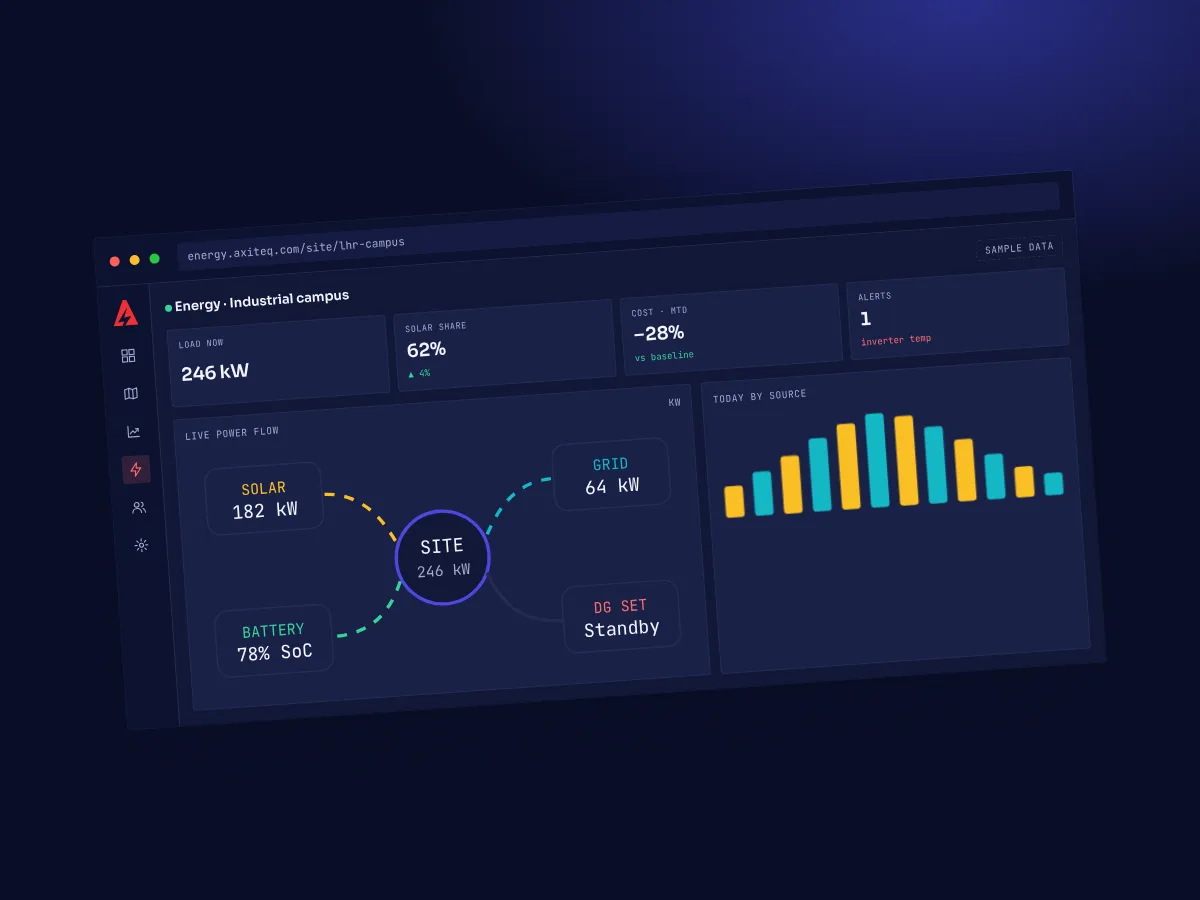
Most organizations know what they pay for energy. Far fewer know where it goes, which source is carrying the load, or which inverter, battery or generator is about to fail.
Energy as a Service from AXITEQ delivers complete energy monitoring and management as a managed monthly subscription. There is no capital expenditure: hardware, installation, cloud and 24/7 NOC are all included.
This article explains what the service covers, how it works from meter to monthly report, and when a subscription makes more sense than buying a monitoring system outright.
01Quick answer: buy a system or subscribe?
Swipe to compare
| Factor | Buy a monitoring system | Energy as a Service |
|---|---|---|
| Upfront cost | Hardware and installation paid upfront (capex) | None: one monthly fee (opex) |
| What is included | Hardware; software and support often extra | Hardware, installation, cloud and NOC |
| Who watches the data | Your team, when it has time | AXITEQ NOC, around the clock |
| Maintenance alerts | Depends on the system | Predictive alerts for inverters, batteries and generators |
| Multi-site view | Often one site per system | Every site on one dashboard |
Pay for energy intelligence, not for hardware. In a representative industrial campus deployment, energy cost reduction was visible within the first billing cycle.
02Every energy source in one view
Sites rarely run on a single source. Solar, batteries, diesel generators and the grid each have their own controllers and screens. Energy as a Service puts them side by side.
Solar
PV generation and harvest tracking.
- Watches
- Generation
- Alerts
- Efficiency drops
Battery
Storage state and cycle analysis.
- Watches
- State of charge
- Alerts
- Health and temperature
Generator (DG)
Runtime, fuel consumption and health.
- Watches
- Runtime and fuel
- Alerts
- Runtime and faults
Grid availability and power quality are monitored alongside, so the team sees which source is carrying the load at any moment and what it costs.
03What the service does
Real-time multi-source monitoring
Solar, battery, DG and grid in one live view.
Consumption analytics
Efficiency benchmarking and cost optimization across sites.
Predictive maintenance
Early alerts for inverters, batteries and generators.
Automated alerts
Low voltage, high temperature, efficiency drops and generator runtime.
Multi-site dashboard
Enterprise-wide energy visibility across every site.
Monthly reports
Consumption, efficiency, cost and sustainability reporting.
04How it works: from meter to monthly report
Data flows from the physical world to decisions and action, in six layers:
Energy assets
Solar PV, inverters, battery banks, DG sets and grid incomers.
Metering
Energy meters, CT sensors and DG fuel-level sensors.
Edge
A gateway with a Modbus interface and store-and-forward buffering.
Cloud core
MQTT ingestion, a rules engine, analytics and benchmarking.
Applications
A multi-site energy dashboard, mobile alerts and monthly reports.
Operations
AXITEQ NOC monitoring and predictive maintenance dispatch.
Installation is a non-invasive retrofit on existing energy equipment, so sites keep running while meters and gateways are fitted. See why retrofit-first IoT beats rip-and-replace.
05The commercial model
One monthly fee covers hardware, installation, cloud and the 24/7 NOC. There is no upfront purchase, and no separate software or support contract to manage.
Advantages
- Zero capex: no capital approval cycle before the first site goes live.
- Every source visible: solar, battery, DG and grid side by side.
- Lower energy cost: savings show from the first billing cycle in representative deployments.
- Someone is watching: the AXITEQ NOC monitors sites and dispatches predictive maintenance.
Challenges
A subscription is a continuing commitment. Agree the sites in scope, the reporting you need and how alerts reach your team before rollout.
06Where it fits
Energy and utilities
Distributed energy assets spread across many sites.
One dashboard and one NOC for every source and site.
Telecom sites
Remote sites that depend on generators, batteries and solar.
Fuel, runtime and battery health without site visits.
Manufacturing campuses
High loads and several sources on one campus.
Benchmarking and cost optimization across lines and buildings.
Commercial buildings
Grid, solar and backup power with no single view.
Every source and its cost in one place.
Energy intelligence, zero capex.
AXITEQ designs, installs and operates the full stack, from meters and gateways to the cloud platform and the 24/7 NOC. Explore Energy as a Service, our AxiOS operations platform and our IoT services.
 Denver (USA)
 Riyadh (KSA)
 Islamabad (PK)
- Sites and energy sources in scope
- Existing meters, inverters and generators
- Reporting and sustainability needs
- Who receives alerts and dispatches maintenance
08Frequently asked questions
What is Energy as a Service?
It is complete energy monitoring and management delivered as a managed monthly subscription: hardware, installation, cloud and a 24/7 NOC for one fee, with no capital expenditure.
Which energy sources can it monitor?
Solar PV, battery storage, diesel generators and the grid, side by side on one dashboard.
Do we need to replace our existing equipment?
No. Installation is a non-invasive retrofit on existing energy equipment, using meters, CT sensors, fuel-level sensors and a gateway.
What alerts does it send?
Automated alerts cover low voltage, high temperature, efficiency drops and generator runtime, plus predictive maintenance alerts for inverters, batteries and generators.
Can it cover several sites?
Yes. A multi-site dashboard gives enterprise-wide energy visibility across every site.
09Final thoughts
Energy as a Service turns energy monitoring from a capital project into a monthly service, with every source visible and someone always watching.
Before choosing an energy monitoring approach, ask three questions- Which sources carry your load today, and what do they cost?
- Who sees an inverter, battery or generator fault first?
- Is a capital approval cycle the real blocker to starting?