On this page
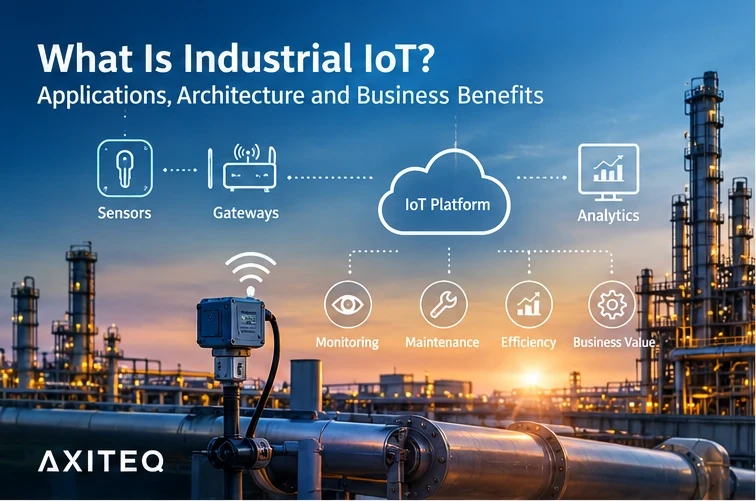
Industrial Internet of Things (IIoT), commonly called Industrial IoT, refers to connected sensors, machines, equipment and software systems that collect and exchange operational data.
Organisations use this data to understand equipment conditions, monitor remote facilities, identify abnormal behaviour and make better operational decisions. Industrial IoT applies connected technology to environments such as manufacturing plants, warehouses, energy installations, telecom infrastructure, cold-chain facilities and commercial buildings.
01What is Industrial IoT?
The objective is not simply to connect equipment to the internet. It is to turn equipment data into information that people and operational systems can act on.
A temperature sensor in a cold room may provide a reading every few minutes. An IIoT solution can collect that reading, compare it against configured limits, notify the responsible team when a threshold is exceeded, and maintain a record for investigation and reporting. The value comes from connecting measurement with action.
02How does Industrial IoT work?
A typical Industrial IoT solution includes several layers. The exact design depends on the equipment, environment, connectivity requirements and operational goals.
Sensors and connected equipment
Sensors measure temperature, humidity, pressure, vibration, current, voltage, flow, position or energy use. Data may also come from equipment that already exposes it, such as PLCs, meters, controllers and machine interfaces.
Connectivity and industrial protocols
Data moves to a local system, gateway or platform over Ethernet, Wi-Fi, cellular, private networks or other industrial technologies, using protocols such as Modbus, OPC UA or MQTT.
Gateways and edge processing
A gateway connects equipment to downstream applications. It may translate protocols, aggregate, filter or validate readings, and buffer data when connectivity is interrupted.
IoT platform and data services
The platform receives and organises device data, with device management, dashboards, rules, alerting, historical records, APIs and enterprise integration.
Operational response and business systems
An alert needs an owner, an escalation path, a maintenance action or a record in an existing system such as maintenance management, ERP, ticketing or reporting.
Collecting large volumes of data without a defined operational purpose can increase complexity without improving decisions. The first design decision is which measurements are useful.
Protocol support should be confirmed against the actual equipment and its configuration rather than assumed from a product brochure. Edge processing can also support local decisions when a response must not depend entirely on a remote cloud service.
A platform should help users understand what is happening across their connected assets, not just display individual sensor readings. AXITEQ’s AxiOS is positioned around connected-asset visibility and operational monitoring: explore the AxiOS platform to see how a central operational view can support connected environments.
The final layer is where an IIoT implementation becomes an operational capability rather than an isolated technology project.
03Industrial IoT applications
Industrial IoT can support a wide range of use cases.
Equipment and condition monitoring
Vibration, temperature, current or other indicators help teams identify unusual equipment behaviour and plan maintenance.
Cold-chain and environmental monitoring
Temperature and humidity sensors monitor storage areas and refrigeration; alerts and history help investigate excursions.
Energy monitoring
Connected meters and sensors show electricity consumption, operating patterns and energy performance across sites.
Telecom infrastructure monitoring
Visibility into environmental readings, power systems and equipment alarms at remote telecom sites.
Fleet and remote asset visibility
Location, operating status, utilisation or condition, depending on the asset and available interfaces.
Building and facility management
HVAC systems, water levels, pumps, indoor conditions and other building equipment.
Monitoring does not automatically deliver predictive maintenance. Reliable prediction requires appropriate data, validated methods and an operating process that acts on the results. Useful energy analysis likewise depends on suitable measurement points and consistent data.
See AXITEQ’s industries and application areas for more examples of connected operational environments.
04What are the business benefits of Industrial IoT?
The benefits depend on the use case, implementation quality and the organisation’s response process. Common objectives include:
Improved visibility
See selected equipment conditions across multiple locations from a central interface.
Faster exception detection
Identify readings or equipment states that require attention.
More informed maintenance
Use operational evidence to prioritise inspections and maintenance.
- Better reporting: historical records for troubleshooting, trend analysis and operational reviews
- More consistent processes: standard thresholds, notifications, ownership and reporting across sites
- Better use of existing assets: connect compatible legacy equipment rather than replacing it only to get monitoring data
These are potential outcomes, not automatic guarantees. Translate them into measurable project objectives before deployment.
05Key considerations before deploying an IIoT solution
- Define the operational problem.
Start with a specific problem, such as unexpected downtime, limited remote visibility, temperature excursions or recurring site alarms, and define how success will be measured.
- Assess equipment and data availability.
Identify existing sensors, controllers, PLCs, meters and interfaces. Check whether readings are accessible, how often they update and whether their quality is sufficient.
- Design for connectivity limitations.
Plan local buffering, retry behaviour, timestamps, data recovery and how the platform shows missing readings.
- Build security into the architecture.
Device identity, authentication, network segmentation, permissions, secure remote access, updates, logging and data protection, alongside safety and availability needs.
- Plan for operational ownership.
Decide who receives alerts, who investigates, when issues escalate and how resolution is recorded. Alerts without owners create noise, not control.
- Deploy in stages.
A pilot validates device compatibility, data quality, connectivity, alert thresholds and workflows before you extend to more assets or sites.
For AXITEQ’s approach to platform and operational security, visit the Security page.
06How to evaluate an Industrial IoT solution
- Does the solution support the equipment and protocols you actually use?
- Can it monitor multiple sites and asset types within a consistent view?
- How are missing, delayed or abnormal readings handled?
- Can alerts be assigned, escalated and tracked through resolution?
- Does it provide useful historical data, reports and integrations?
- How are devices, users, permissions and remote access secured?
- Can the architecture scale without unnecessary complexity?
- Can the provider demonstrate the proposed workflow using your real use case?
The best solution is not necessarily the one with the largest feature list. It is the one that fits your operational requirements and can be maintained reliably.
Map your assets, data and actions with an engineer.
Bring the assets you want to monitor and the decisions that should follow.
From equipment data to operational value.
Industrial IoT brings equipment data, connectivity and software together; its value comes when that information helps teams recognise exceptions, decide and act. AXITEQ helps organisations explore connected monitoring, Industrial IoT integration and operational visibility across distributed environments. Learn more about our IoT services and the AxiOS platform.
 Denver (USA)
 Riyadh (KSA)
 Islamabad (PK)
- The assets you want to monitor
- The information you need from them
- The action that should follow an alert
08Frequently asked questions
What is Industrial IoT (IIoT)?
Industrial IoT refers to connected sensors, machines, equipment and software systems that collect and exchange operational data, so organisations can monitor conditions, spot abnormal behaviour and make better operational decisions.
What are the main layers of an IIoT architecture?
Sensors and connected equipment, connectivity and industrial protocols, gateways and edge processing, an IoT platform with data services, and the operational response connected to business systems.
Which protocols does Industrial IoT use?
Common examples include Modbus, OPC UA and MQTT. Support should always be confirmed against the actual equipment and its configuration.
Does Industrial IoT deliver predictive maintenance automatically?
No. Monitoring provides the data, but reliable prediction needs appropriate data, validated methods and a process that acts on the results.
How should an IIoT project start?
With a specific operational problem, an assessment of existing equipment and data, a security-aware design and a staged pilot before wider rollout.
09Final thoughts
Industrial IoT works when measurement is connected to action: a clear problem, a suitable architecture and a defined response process, expanded in measured stages.
Before designing a solution, decide three things- Which assets do you want to monitor?
- What information do you need from them?
- What action should follow an alert?