On this page
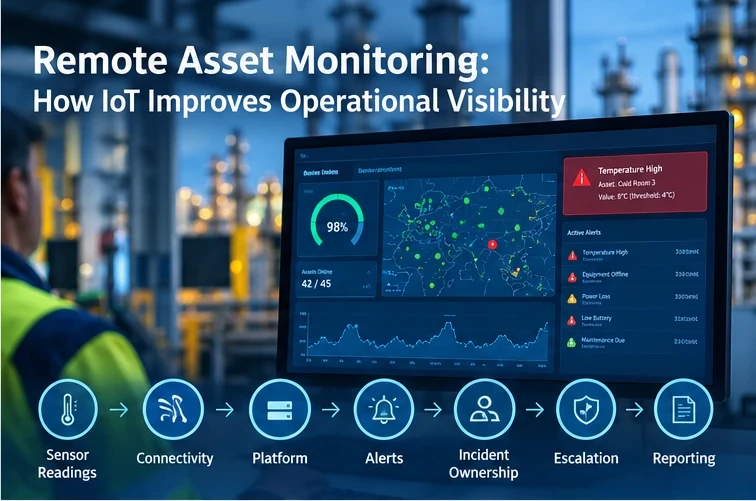
Remote asset monitoring uses connected devices and software to observe the condition, status or performance of equipment without requiring someone to visit each location for every routine check.
Assets may include refrigeration units, pumps, generators, industrial machines, telecom infrastructure, energy systems, storage facilities and building equipment. Sensors and connected controllers provide temperature, pressure, vibration, energy consumption, operating state or equipment alarms, and the monitoring system notifies authorised teams when defined conditions need attention.
01What is remote asset monitoring?
Monitoring is only the first step. Operational visibility improves when readings are connected to clear thresholds, responsible people, escalation procedures and records of what happened next.
02How IoT remote monitoring works
An effective monitoring process follows a lifecycle from data collection to operational resolution.
Collect sensor and equipment data
Measure what fits the asset: a cold room may need temperature, a pump installation pressure, run-state or vibration. Base the reading frequency on risk, equipment behaviour and the response time needed.
Transfer data reliably
Through a controller, gateway or direct connection, designed for disconnections, delayed messages, restarts and buffering, so users can tell a normal reading from a device that stopped reporting.
Validate readings and apply thresholds
Rules evaluate readings against limits, plus separate rules for sensors that miss their expected interval. Persistence periods, hysteresis or alert levels reduce noise from brief fluctuations.
Generate an actionable alert
Identify the asset, site, condition, event time, threshold and next step, delivered by app, email, SMS or an integrated ticketing system.
Assign ownership and manage the incident
Someone reviews the event, decides on action, coordinates the response and records the outcome. An alert is not the same as a resolved problem.
Review history and report performance
Alert volumes, recurring exceptions, response times, unresolved incidents and equipment availability, with clearly defined metrics.
A dashboard that displays the last known value without showing its age can create a false sense of confidence. Test rules against realistic conditions before using them for operational decisions.
A well-designed response process should answer these questions:
- Who owns the initial investigation?
- How quickly should the event be acknowledged?
- When must it be escalated?
- What evidence is required to close it?
- How are repeat incidents identified?
03Illustrative example: monitoring a remote cold room
This is an illustrative scenario, not a reported AXITEQ customer result.
A company operates several cold rooms across different locations. Staff record temperatures manually, and managers have limited visibility between inspections. The company installs suitable temperature sensors and connects them to a remote monitoring platform.
Measurement
The sensor reports the cold room’s temperature at a configured interval.
Connectivity
A gateway or connected device forwards readings to the platform.
Rule evaluation
The platform compares readings with the approved operating thresholds.
Notification
A sustained excursion generates an alert with the site, asset and measured condition.
Ownership
The designated site or operations team receives and acknowledges the alert.
Escalation
If the issue stays unresolved, the procedure notifies the next responsible person.
Investigation
The team checks the refrigeration system, sensor condition and other factors.
Closure and reporting
The response and findings are recorded and stay available for review.
This workflow can improve visibility between manual inspections. It does not, by itself, guarantee product safety or regulatory compliance; those depend on validated procedures, suitable equipment, calibration, recordkeeping and the applicable requirements.
04What should a remote monitoring system include?
Not every application needs the same feature set. Useful capabilities often include:
Centralised asset visibility
A consistent way to see sites, assets, device status and current readings, with clear naming and hierarchy as deployments grow.
Configurable alerts
Rules that reflect real operating requirements and separate urgent conditions from informational events.
Incident ownership and escalation
Acknowledgement, assignment, escalation and closure, so alerts do not remain unattended.
Historical records and reporting
Readings and event history to investigate problems, compare sites and support reviews.
Integration capabilities
APIs and integrations with enterprise systems, service desks and maintenance workflows.
Security and access control
Role-based access, secured remote connections and logged actions. See the Security page.
05Common remote monitoring challenges
- Too many alerts.
Overly sensitive thresholds cause notification fatigue. Review real data, separate severity levels and make sure each alert has a meaningful action.
- Missing or stale data.
Devices lose power, connectivity or sensors. Identify missing reports and show data freshness so an old reading is not mistaken for a current one.
- Unclear responsibility.
Alerts get acknowledged without being resolved. Set ownership and escalation rules before deployment.
- Inconsistent site configurations.
Different names, units and thresholds make reporting hard. Standardise where possible, allowing for real differences.
- Unclear success criteria.
Device counts alone prove little. Measure reduced manual checks, better acknowledgement, visibility of open incidents or more complete records.
06How to select an IoT asset monitoring solution
- Can it connect to the sensors and equipment already deployed?
- Does it show device connectivity and data freshness?
- Can alert rules be configured for different asset types and locations?
- Can incidents be assigned, escalated and tracked?
- Are historical readings and event records available?
- Can the solution integrate with existing business systems?
- How are users, devices and remote connections secured?
- What support, maintenance and expansion model is proposed?
A good evaluation uses a real workflow rather than a generic demonstration. Select one asset type, define a threshold, simulate an event and verify how the alert reaches the responsible person and is recorded through resolution.
From monitoring to operational control.
Remote asset monitoring gives teams a consistent view of distributed equipment; its effectiveness depends on reliable data, appropriate rules and a response process that assigns responsibility. AXITEQ works on connected monitoring and operational visibility solutions designed around real equipment and site requirements. Explore our services and the AxiOS platform.
 Denver (USA)
 Riyadh (KSA)
 Islamabad (PK)
- Which asset condition would you most want to know about before someone discovers it on site?
08Frequently asked questions
What is remote asset monitoring?
It is the use of connected devices and software to observe the condition, status or performance of equipment without visiting each location for every routine check.
How is an alert different from an incident?
An alert signals a condition. Someone still has to review it, decide whether action is needed, coordinate the response and record the outcome.
Why does data freshness matter?
A device may stop reporting. If the dashboard shows the last known value without its age, users may mistake an old reading for a current condition.
Does remote monitoring guarantee compliance?
No. It can improve visibility, but product safety and compliance depend on validated procedures, suitable equipment, calibration, recordkeeping and the applicable requirements.
How should we evaluate a monitoring solution?
Use a real workflow: pick one asset type, define a threshold, simulate an event and check how the alert reaches the right person and is recorded through resolution.
09Final thoughts
Remote monitoring improves operations when every reading can become an owned, escalated and recorded response, not just a number on a dashboard.
Before choosing a system, ask three questions- Which asset conditions matter most?
- Who owns each alert, and when does it escalate?
- How will you know the system is improving operations?