On this page

Many industrial IoT programmes stall before they deliver anything, because they begin with replacing equipment.
New machines need budget approval, installation windows and downtime, and the business case waits for all of it. AXITEQ takes the opposite approach: retrofit first.
Retrofit-first means connecting the equipment you already run, getting reliable data from it, and only then deciding what, if anything, needs replacing. It is the fastest route from an IoT idea to a measurable result.
01Quick answer: retrofit first or rip and replace?
Swipe to compare
| Factor | Rip and replace | Retrofit first |
|---|---|---|
| Starts when | After a capital approval cycle | As soon as the survey is done |
| Production downtime | Needed to install new equipment | None: sensors are non-invasive |
| First data | After the full programme | Within weeks, from the pilot |
| What changes | Hardware, software and processes at once | Visibility first, changes later |
| Replacement decisions | Made up front, on assumptions | Made later, on evidence |
Most equipment in factories, cold rooms and remote sites still works well. What is missing is visibility, not new machines.
02Why rip-and-replace stalls
- It waits for a capital cycle.
Replacing machines or panels needs budget approval, so the project starts months later than it could.
- It needs downtime.
Installing new equipment means stopping production lines, chillers or sites, which operations teams resist for good reason.
- It changes too much at once.
New hardware, new software and new processes arrive together, so problems are hard to isolate.
- It delays proof.
Nobody sees data, alerts or savings until the whole programme is in place.
03The four layers of a retrofit
1. Read what is already there
PLCs, meters and building systems can usually be read over Modbus, OPC-UA or BACnet without changing their programs. This is often the quickest win.
2. Add sensors only where data is missing
Clamp-on current sensors, temperature probes, vibration sensors and door contacts fit without opening the process or changing how the equipment runs.
3. Connect through an edge gateway
A gateway collects readings and sends them over 4G/LTE, LoRaWAN or the site network, storing data locally when the connection drops.
4. Turn data into operations
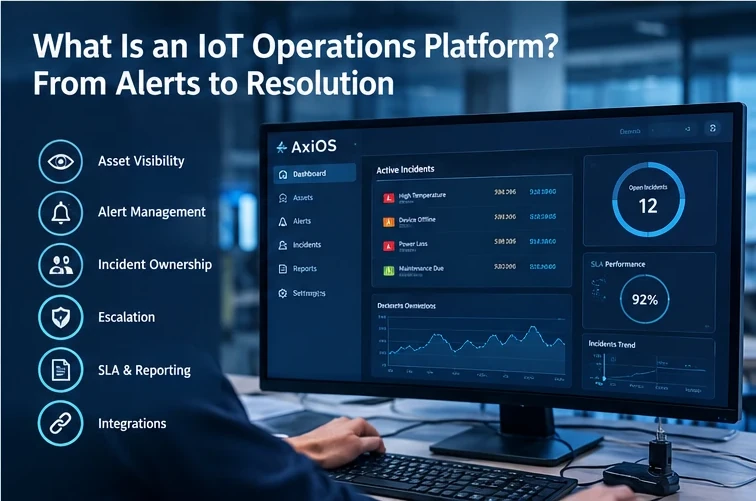
Readings feed dashboards, alerts and analytics. On AxiOS, alarms become incidents with SLA timers, handled by AXITEQ’s 24/7 NOC.
04Where retrofit-first fits best
Manufacturing
Machines on existing lines run without visibility into health, energy or downtime.
Machine monitoring, energy metering and predictive maintenance on the lines you already run.
Cold chain and retail
Chillers and cold rooms are checked by hand, and failures are found too late.
Temperature monitoring and alarms on installed units. See (how a 24/7 NOC handles cold chain alarms)(/news/cold-chain-noc/).
Energy and telecom sites
Generators, solar inverters and batteries sit at remote sites that are expensive to visit.
Remote monitoring of the assets in place, without replacing them.
Buildings and campuses
Building systems work, but each has its own screen and nobody sees the whole picture.
Existing building management systems connected into one view.
05Timelines
Because nothing has to be replaced first, retrofit projects move quickly. A typical sequence is a site survey, an architecture for sensors, connectivity and cloud, a pilot on a limited set of assets, then rollout and 24/7 operations.
Survey and design
Assets, data points, connectivity
What can be read directly, where sensors are needed and how data leaves the site.
Pilot
As little as 30 days
Validates data quality, alerts and the business case on a small scale.
Enterprise rollout
Typically 60 to 180 days
Depending on scope, site count and integration complexity.
06How to prepare for a retrofit pilot
A short list of information makes the first survey faster and the pilot more useful:
- The outcome you want to measure, such as downtime, energy use, temperature compliance or fuel consumption
- A list of the assets in scope, with make, model and age where known
- The controllers and systems already on site (PLCs, SCADA, BMS, ERP) and who maintains them
- Connectivity at each site: network access, mobile coverage, or neither
- Who should receive alerts, and what should happen when one fires
- Two or three representative sites for the pilot, ideally one easy and one difficult
Talk it through with an IoT engineer.
We will tell you what can be read today and what needs a sensor.
07When replacing equipment is the right call
Retrofit-first is not retrofit-only. Some equipment is at the end of its life, unsafe or impossible to connect, and replacing it is the right decision.
The difference is that retrofit data shows you which assets those are, so replacement budgets go where they matter, backed by evidence instead of assumptions.
Design, deploy and operate, from one team.
AXITEQ designs, deploys and operates retrofit IoT systems, from sensors and gateways to cloud platforms and a 24/7 NOC. Explore our IoT and Industrial IoT services and industrial automation.
 Denver (USA)
 Riyadh (KSA)
 Islamabad (PK)
- The outcome you want to measure
- Assets, controllers and systems on site
- Connectivity at each site
- A pilot scope and timeline
09Frequently asked questions
Will a retrofit disrupt production?
No. Sensors are non-invasive and controllers are read rather than reprogrammed, so operations keep running during installation.
Can you connect old or mixed-brand equipment?
In most cases. Standard industrial protocols cover a wide range of PLCs, meters and controllers, and add-on sensors cover equipment with no data output at all.
What happens if the site loses connectivity?
Edge gateways store readings locally and send them when the connection returns, so data is not lost.
How quickly can we see results?
Pilots can go live in as little as 30 days, which is usually enough to validate data quality, alerts and the business case before a wider rollout.
10Final thoughts
Retrofit-first gets data flowing from the equipment you already own, proves value in weeks, and lets evidence decide what to replace.
Before planning an IoT programme, answer three questions- What outcome will prove the project worked?
- Which assets already produce the data you need?
- Which sites make a fair, representative pilot?