On this page
Temperature-sensitive products can be exposed to changing conditions during storage, handling and transportation.
For organisations operating cold rooms, refrigerated warehouses, distribution facilities or temperature-controlled vehicles, knowing the current temperature is important, but understanding what happened over time is equally valuable. Cold chain monitoring uses sensors and connected systems to collect and review environmental data across relevant locations and equipment. With appropriate alerting and recordkeeping, teams can identify excursions, investigate events and maintain a more consistent view of conditions.
01What is cold chain monitoring?
IoT can make this information available remotely, reducing dependence on isolated manual checks. However, a monitoring platform is only one part of a cold-chain control process. Equipment suitability, calibration, handling procedures and applicable quality or regulatory requirements remain essential.
Cold chain monitoring is the observation and recording of conditions that may affect temperature-sensitive products as they move through storage, transport and distribution. Depending on the product and operating requirements, monitoring may include:
Not every application requires every measurement. The monitoring design should reflect the product, required conditions, facility layout and risk assessment.
02How IoT cold chain monitoring works
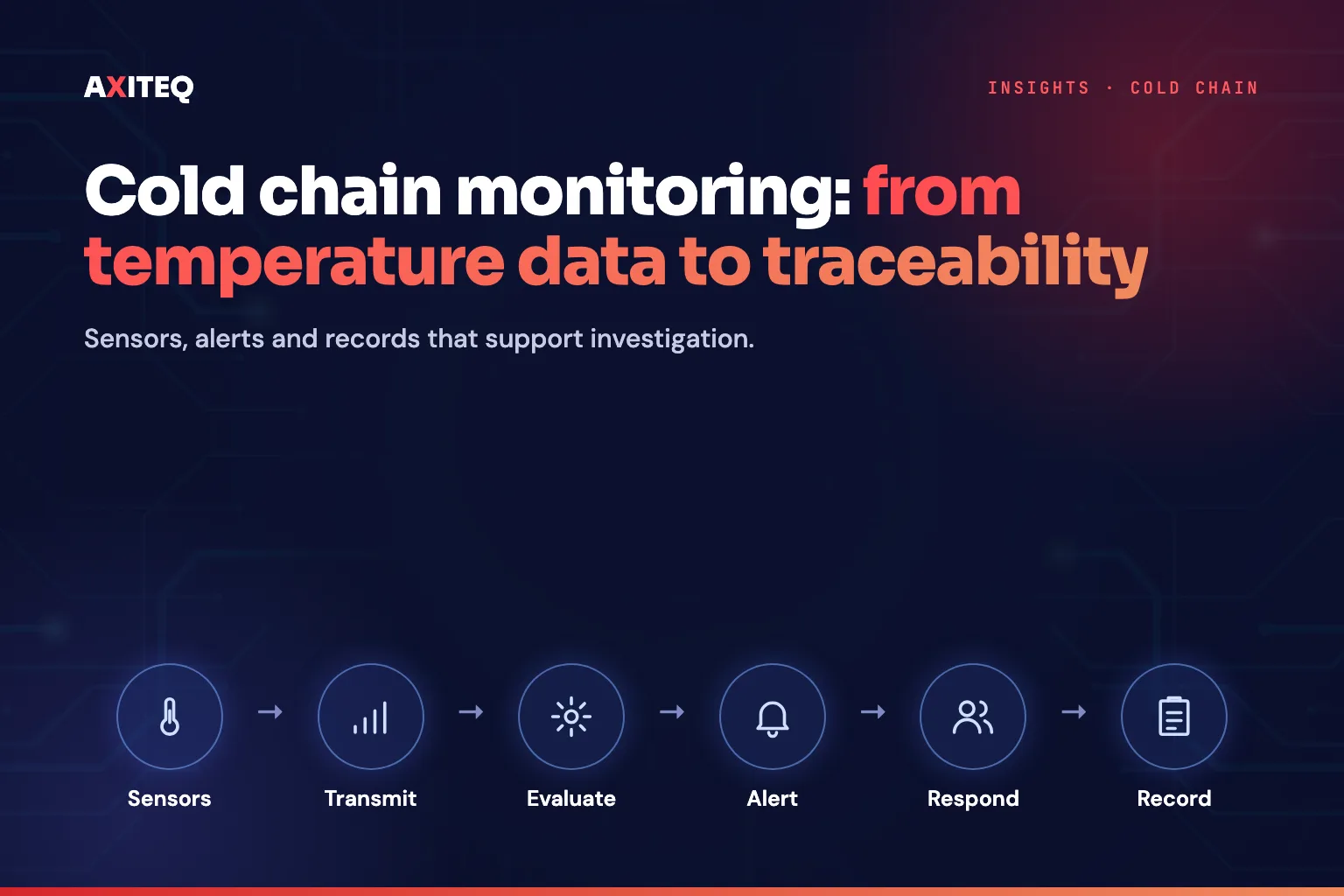
Sensors measure environmental conditions
Sensors collect measurements at selected locations, such as a cold room, refrigerated cabinet, warehouse zone or transport compartment. Placement matters: a single sensor may not represent conditions throughout a large space, so account for airflow, doors, equipment, product location and known temperature variations. Where monitoring supports quality decisions, assess sensor accuracy, calibration and suitability against the relevant requirements.
Devices transmit readings
Readings may be sent through a local gateway, wired connection, Wi-Fi, cellular connectivity or another suitable network. Depending on the system, devices may store readings locally and forward them when communication returns. The platform should distinguish between a current measurement and the last measurement received; missing data can itself require investigation.
The platform evaluates conditions
Incoming readings are compared with configured thresholds and rules. Rules may account for the permitted operating range, how long a condition persists, or whether a device has stopped reporting. Review alert thresholds with the responsible quality or operations team rather than selecting them solely for convenience.
Alerts notify responsible teams
A useful alert identifies the affected location, monitored asset, event time and relevant measurement. Escalation rules help ensure important events receive attention if the first notification is not acknowledged. Notifications do not replace an approved response procedure: staff need clear instructions for checking the condition, protecting affected products and documenting decisions.
Historical records support investigation
A record of readings and events helps teams reconstruct the sequence of conditions, review excursions and support internal quality processes. Its usefulness depends on accurate timestamps, consistent sensor identification, appropriate retention and the ability to retrieve data for the required period.
Where electronic records are used for compliance purposes, organisations should verify the applicable requirements and validate the system accordingly.
03Why temperature monitoring alone is not enough
A temperature dashboard provides a view of measured conditions. Operational traceability requires additional context. Teams may need to know:
- Which sensor produced the reading?
- Where was the sensor located?
- Was it calibrated and operating correctly?
- When did the excursion begin and end?
- Was the data complete?
- Who received the alert?
- What action was taken?
- How was the affected product assessed?
- Where is the relevant record stored?
The required level of traceability depends on the product, business process and applicable obligations. An IoT platform can help organise relevant information, but it should not be assumed to provide every compliance function automatically.
04Illustrative example: a cold storage excursion
This is an illustrative scenario, not a reported AXITEQ customer result. A distribution facility stores temperature-sensitive products in a monitored cold room.
Detection
A sensor reports a temperature outside the facility’s configured operating range, and the platform detects the excursion.
Notification
The platform sends an alert to the responsible operations team.
Response
The team acknowledges the event, checks the refrigeration equipment and follows the site’s approved procedure.
Product assessment
Staff assess the affected products using the relevant quality process, record the findings and document any corrective action.
Review
The team reviews the sensor history, equipment status and response timeline to investigate the cause and decide whether equipment, procedures or monitoring rules need to change.
The monitoring system provides visibility and evidence. Product disposition and safety decisions remain with authorised personnel following applicable procedures.
For how a staffed operations centre handles these events around the clock, see cold chain monitoring with a 24/7 NOC.
05Common challenges in cold chain monitoring
- Poor sensor placement.
A sensor in an unrepresentative location may not reveal conditions elsewhere in the storage area. Review placement during commissioning and when layouts or equipment change.
- Inaccurate or uncalibrated sensors.
Monitoring decisions depend on measurement quality. Establish appropriate calibration, inspection and replacement procedures.
- Delayed or missing readings.
Network failures, depleted batteries, device faults or gateway problems can create gaps. Configure appropriate device-health and missing-data alerts.
- Too many notifications.
Poorly tuned thresholds create repeated alerts that are hard to prioritise. Review real operating data and make sure each notification has a clear purpose and response.
- Incomplete event records.
A temperature graph may not explain who responded or what was done. Define how acknowledgement, investigation, corrective action and closure are documented.
- Fragmented monitoring across sites.
Different naming conventions, devices and reporting methods make comparisons difficult. Standardise configurations where possible while retaining site-specific requirements.
06How to evaluate a cold chain monitoring solution
Measurement requirements
Does the proposed sensor meet the accuracy, range and environmental requirements of the application?
Data availability
How frequently are readings collected, and what happens during connectivity interruptions?
Alert configuration
Can rules reflect the required limits and response procedures?
Traceability
Can users retrieve readings, timestamps, device identity, calibration information where supported, and event history?
Incident handling
Can events be acknowledged, assigned, escalated and documented?
Security
Are user access, device communications, remote access and data retention appropriately controlled?
Integration
Can monitoring information connect to existing quality, maintenance or enterprise systems where required?
Deployment and support
Who installs, commissions, maintains and verifies the system?
Use a representative cold room or transport use case to test the full process before expanding the deployment.
07How AXITEQ approaches connected monitoring
AXITEQ works across connected monitoring and operational visibility use cases. Its AxiOS platform is relevant to organisations exploring centralised visibility for connected assets, while the industries page provides context on the environments AXITEQ serves.
Any proposed cold-chain solution should be assessed against the actual requirements for sensors, calibration, alerts, records, integrations and operational procedures.
From temperature data to traceable response.
Cold chain monitoring connects environmental measurements with remote visibility, alerts and historical records. When designed around reliable sensors and clear response procedures, it can help teams identify excursions and investigate conditions across distributed facilities. Explore AXITEQ’s services or contact AXITEQ to discuss connected monitoring for cold storage, refrigeration or temperature-sensitive operations.
 Denver (USA)
 Riyadh (KSA)
 Islamabad (PK)
- Appropriate measurement
- Dependable data collection
- Defined ownership
- A traceable response process
09Frequently asked questions
What is cold chain monitoring?
The observation and recording of conditions that may affect temperature-sensitive products as they move through storage, transport and distribution, such as temperature, humidity, door events and equipment status.
How does IoT cold chain monitoring work?
Sensors measure conditions, devices transmit readings, a platform evaluates them against thresholds, alerts notify responsible teams, and historical records support investigation.
Why is a temperature dashboard not enough?
Traceability also needs context: which sensor produced the reading, whether it was calibrated, when an excursion began and ended, who was alerted, what action was taken and where the record is stored.
Does cold chain monitoring guarantee compliance?
No. A platform can help organise relevant information, but compliance depends on suitable equipment, calibration, procedures, validation and the applicable requirements.
Where should cold chain sensors be placed?
Placement should account for airflow, doors, equipment, product location and known temperature variations, and be reviewed during commissioning and whenever layouts or equipment change.
10Final thoughts
Cold chain monitoring works best when measurement, data collection, ownership and response are designed together, so every excursion leaves a traceable record.
Before selecting a system, confirm- What you need to measure, and where
- Who responds to each alert
- How events are documented and retrieved