On this page
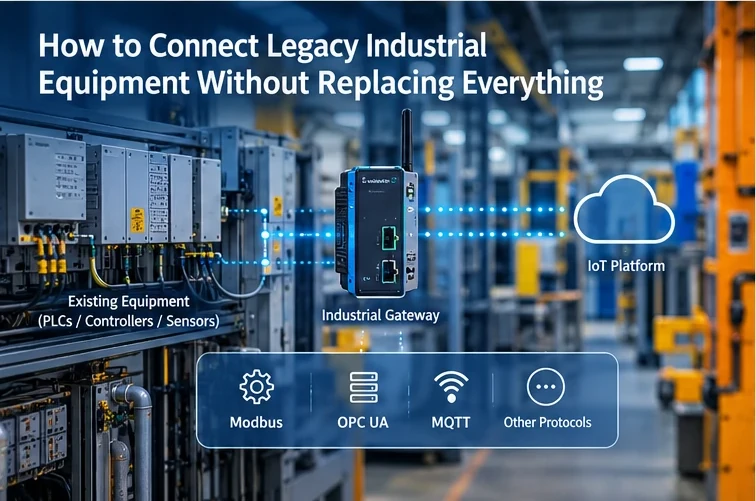
Many industrial facilities rely on equipment that has operated reliably for years. Machines, PLCs, meters and controllers may perform their original functions well but provide limited visibility outside the local control environment.
Replacing all this equipment solely to introduce remote monitoring can be expensive, disruptive and unnecessary. Industrial IoT integration offers another approach: assess the existing equipment, identify accessible data and introduce the appropriate connectivity and software layers around it.
01Connecting existing equipment to Industrial IoT
Not every machine can be connected in the same way. The right method depends on its interfaces, protocols, control requirements, condition and the operational value of the data.
The approach below follows seven steps, from site assessment to staged deployment. For the thinking behind it, see why retrofit-first IoT beats rip-and-replace.
02Step 1: Assess the existing site
Begin with an inventory of the equipment and the information you want to collect. Document:
- Equipment type, manufacturer and model where available
- PLCs, controllers, meters and existing sensors
- Available communication ports and protocols
- Network layout and connectivity constraints
- Critical operating and safety requirements
- Data points required for monitoring
- Existing alarms, maintenance systems and reporting processes
The goal is to determine whether the required information is already available, can be exposed safely or needs additional sensors. One controller may already report operating status and temperature; another machine may expose only a few signals; a third may have no accessible interface at all. These situations need different integration designs.
03Step 2: Identify supported protocols
Industrial equipment communicates through a variety of interfaces and protocols, which may include Modbus RTU, Modbus TCP, OPC UA, vendor-specific interfaces or other industrial methods.
Protocol names alone do not establish compatibility. A Modbus-capable gateway still needs the correct register map, data types, scaling and communication parameters. Incorrect register interpretation can produce data that looks plausible but does not reflect the actual operating condition.
Before deployment, verify the documentation and test representative readings.
04Step 3: Choose the right integration method
There are three common approaches.
Use the existing controller or PLC
Where the PLC exposes the data through a supported interface, a gateway or connector collects it. Minimal hardware change; access must be agreed with the controls engineer so reading never interferes with control logic.
- Hardware change
- Minimal
- Needs
- Controls approval
Add an industrial gateway
Bridges local industrial protocols and the IoT platform; can aggregate, normalise and buffer data. Choose on protocols, environmental rating, temperature, power, capacity, security and remote maintenance.
- Hardware change
- Gateway
- Needs
- Site-suitable device
Install additional sensors
When equipment does not expose the measurement. Useful for older machines; assess placement, mounting, calibration, power, cabling and environment.
- Hardware change
- New sensors
- Needs
- Careful installation
The gateway should be appropriate for the actual industrial environment, not just compatible on paper. A retrofit sensor can provide useful monitoring data without becoming part of the machine’s original control system.
05Step 4: Design the data path
A typical retrofit architecture looks like this:
Existing equipment or sensor
The PLC, controller, meter or retrofit sensor that holds the data.
Industrial gateway or edge device
Reads, translates, buffers and forwards selected data.
Secure network connection
Moves data under the site’s security policies.
IoT platform
Organises device data, rules and history.
Dashboards, alerts and integrations
Where information reaches people and business systems.
Decide which data to collect, how often to send it, where to process it and how to handle temporary communication failures. Not every signal needs to be transmitted continuously: balance operational value, bandwidth, storage and the response time required.
06Step 5: Validate data quality
Connectivity is not the same as correct data.
- Values use the correct units and scaling
- Timestamps and time zones are handled consistently
- Missing readings are identified
- Duplicate messages do not create misleading event records
- Sensor values are plausible for the operating environment
- Data stays interpretable after device restarts or connectivity interruptions
Where readings drive alerts or maintenance decisions, validation should include realistic operating conditions and documented acceptance criteria.
07Step 6: Secure the integration
Connecting previously isolated equipment can introduce new network paths and access requirements, so security belongs in the initial architecture.
Network design
Network segmentation, firewall rules and least-privilege access.
Identity and credentials
Device identity, secure protocols where supported, credential management and firmware updates.
Logging and change control
Who may change configurations, how changes are reviewed, and logging of actions.
Remote access
Never expose industrial controllers directly to the public internet; use a secured, managed design that follows site policy.
Operational technology can have availability and safety requirements that differ from ordinary IT systems. For more, visit the AXITEQ Security page.
08Step 7: Deploy in stages
A staged rollout helps uncover compatibility and operational issues before a large deployment.
Pilot
One representative machine or site
Confirm data points, connectivity, timestamps, alert rules and the user workflow.
Validate
Against trusted local measurements
Test missing data, threshold events, access controls and recovery after interruptions.
Standardise, then expand
Documented, repeatable design
Document configuration, naming, mapping and support, then extend to similar assets.
09When is equipment replacement necessary?
An IoT retrofit is not always the best option. Replacement or major modification may be appropriate when equipment is unsafe, unreliable, unsupported, incompatible with required measurements or unable to meet performance and compliance needs, or when maintaining it costs more than extending its life is worth.
The decision should consider the equipment’s condition, downtime risk, maintenance requirements, integration effort, future support and expected operational benefit.
The objective is not to avoid replacement at all costs. It is to make replacement decisions based on a clear technical and business case.
10Common mistakes to avoid
- Assuming every protocol implementation is identical.
Confirm the exact interface, register map and data interpretation.
- Collecting too much data.
Begin with the readings required to support a defined decision or workflow.
- Ignoring the controls team.
Coordinate with the people responsible for machine operation, safety and maintenance before connecting new devices.
- Treating cybersecurity as a later task.
Review network paths, permissions and remote access before enabling connectivity.
- Scaling before validating.
Test a representative installation and document a repeatable design before expanding.
- Measuring success only by device count.
Evaluate data reliability, useful alerts, operational adoption and the quality of decisions supported.
Legacy equipment, modern operations.
Industrial IoT integration can extend the visibility of existing assets without wholesale replacement. The strongest projects start with a site assessment, confirm protocol and data compatibility, secure the integration and validate the workflow through a staged deployment. Learn about our IoT services, industrial automation and the AxiOS platform.
 Denver (USA)
 Riyadh (KSA)
 Islamabad (PK)
- A short list of assets
- The measurements you need
- The decisions those measurements should support
12Frequently asked questions
Can legacy industrial equipment be connected to an IoT platform?
Often, yes. Depending on its interfaces, data can come from the existing PLC or controller, through an industrial gateway, or from additional sensors where the equipment exposes nothing suitable.
Is Modbus support enough to connect a machine?
No. The integration also needs the correct register map, data types, scaling and communication parameters, verified with representative test readings.
Will reading data from a PLC affect the machine?
It should not, but access must be reviewed with the equipment owner or controls engineer so reading operational data never interferes with control logic or availability.
How do we keep the integration secure?
Segment the network, apply least-privilege access, manage device identity and credentials, log changes and never expose industrial controllers directly to the public internet.
When should equipment be replaced instead?
When it is unsafe, unreliable, unsupported, unable to provide the required measurements, or when keeping it costs more than the value of extending its life.
13Final thoughts
Connecting legacy equipment is a series of careful decisions: what data exists, how to reach it safely, whether it is correct, and how to scale what works.
Before planning a retrofit, answer three questions- Which assets matter most?
- Which measurements do you need from them?
- Which decisions should those measurements support?